


September is National Suicide Prevention Month
This topic matters to me every day
By Joanna Barrett
TL;DR:
A gentle note before you begin: This is a longer, heavier, but deeply meaningful post. Please feel free to take your time, pick and choose the sections that feel supportive to you, or return to it when you’re ready. Additional resources are included at the bottom of the post.
September is National Suicide Prevention Month, a cause that is deeply personal and professional for me. I have experienced the loss of someone I loved to suicide, lived through my own seasons of quiet despair. I have also spent years as a therapist, advocate, and volunteer supporting people through some of the darkest chapters of their lives. Each time I hear of another person dying by suicide, especially a child or young person, my heart breaks for the life they did not get the chance to live. Their stories remind us to take mental health struggles, bullying and cyberbullying, isolation, burnout, and cries for help seriously. They also remind us that suicide prevention is about more than responding to someone in crisis.
It is about creating connection and belonging, reducing stigma, changing unhealthy systems, caring for those who care for others, and building communities where people know they matter. We may not always be able to take away someone’s pain, but we can listen, stay, help them find support. And also hold hope for them when they cannot hold it for themselves. Remember, there are still people you have not met, places you have not been. Chapters of your story you cannot see yet. Stay for the next chapter.
If you are struggling or thinking about suicide, please do not carry this alone. Tell someone you trust and reach out for support.
In the United States, call or text 988 to connect with the 988 Suicide & Crisis Lifeline, available 24/7. If you believe you or someone else is in immediate danger, call 911 or go to the nearest emergency department. If you are worried about someone, reach out. Ask how they are really doing, listen without judgment, and help them connect with support.
September is National Suicide Prevention Month
For me, this month is not simply another awareness campaign or a collection of graphics shared across social media. Suicide prevention is deeply personal. It is woven through my life experiences, people I have lost, and stories I have carried with me for years. As well as the work I have chosen to do as a mental health therapist, advocate, and human being who deeply believes in the importance of connection.
Each time I hear about someone dying by suicide, my heart breaks. And when I hear about a young person taking their own life, there is something about it that feels especially devastating. I think about the life they might have lived. The relationships they might have formed. The places they might have traveled. The work they might have done. The person they might have become. I think about everything that can change in a year, five years, ten years, or twenty years.
I know this because I have lived enough life now to look backward and recognize that some of the hardest chapters of my own life were exactly that: chapters. They were not the whole story. When we are in the middle of tremendous emotional pain, however, it can be nearly impossible to see beyond the moment we are living. The pain can feel permanent even when our circumstances are not. This is one of the reasons suicide prevention matters so deeply to me. Sometimes another person needs to help us hold onto hope until we are able to hold it for ourselves again.
One of My First Experiences With Suicide
When I was still in college I experienced losing someone by suicide. During our senior year in 2007, I learned that a close friend from high school, Kelly, had died by suicide in her dorm room. Kelly was only 21, a senior at Mount Holyoke College and only six months away from graduating, with such a bright future ahead of her.
Some moments in life make the world stop for a second. For me, this was one of them. I had just seen her at Blockbuster during our Thanksgiving break, just a month or so before her passing. We were still so young. Young women who were supposed to be thinking about graduation, first jobs, apartments, relationships, and whatever adventures adulthood might bring. We were supposed to have so much life ahead of us. Instead, Kelly was gone, way too soon. And I felt the weight of that immense loss of a friend. A friend who was always kind, inclusive, fun, and close with me in high school. This left me with warm memories and a complex confusion of many unknowns.
When someone dies by suicide, those who remain are left not only with grief, but often with so many unanswered questions. We wonder what someone was carrying that we could not see. We wonder whether there was something we could have noticed. Something we could have said, or some way we could have helped. Over the years, and especially through becoming a therapist, I have come to understand more deeply that we cannot always know the internal world of another person.
Someone can be accomplished and struggling. Smiling and also suffering. Someone can be deeply loved and still feel profoundly alone. They can appear to have everything going for them while privately experiencing despair. Someone can even have plans for the future and struggle to imagine themselves actually living into that future.
Kelly’s death became one of the defining moments in how I came to understand the secrecy of mental health. Although I could not have known then where my own path would eventually lead.
I chose to write about this because I knew what it was like to lose someone young. Wonder about all of the life she never had the chance to live. This was long before I became a therapist, and long before suicide prevention became part of my professional work.
And Then I Found Myself Struggling, Too
Not long afterward, I began to understand emotional suffering from another perspective: my own. After I graduated from college, I went through a period of quiet despair. Years later, I would write about part of this chapter in a personal narrative, “How Yoga Saved Me.” Published in 2016 on Elephant Journal and later updated on Chasing Red Flags). These personal narratives are some of the most vulnerable pieces of writing I have shared.
From the outside, there were many reasons I should have been happy. I had graduated magna cum laude. Had been successful in college, starting a sorority on campus, editor-in-chief of my college newspaper, working in the executive office, and being a board member of an event planning club. I had many incredible accomplishments behind me and a future of possibilities ahead of me. I was supposed to be excited about beginning my adult life.
But our internal lives do not always correspond neatly with what the outside world thinks we should be feeling. With a new job, a long commute, and living back at home, I was struggling. I felt overwhelmed, anxious, uncertain, and disconnected from myself. It felt like I was living in the dark, depressed and hopeless, with thoughts that scared me.
I did not yet have the language, tools, wisdom, or perspective I have today. I could not see where my life was ultimately taking me. Because, of course, none of us can see the whole path while we are standing at the beginning of it.
Yoga Showed Me Things Could Change
In 2009, at 23 years old, I stepped onto a yoga mat. Simply because I was looking for something to help decrease my stress, anxiety, and overwhelm. I could not possibly have known then how much that practice would eventually become part of my life. Yoga slowly helped me reconnect with my body, my breath, myself, and eventually a deeper sense of meaning and purpose.
Yoga did not magically make everything difficult disappear. Healing rarely works that way. Instead, yoga gave me practices. It gave me moments of quiet. Helped me learn to stay present with myself. It taught me to listen differently to my body and emotions. Yoga also helped me discover that feelings move and change and that I could experience discomfort without being completely consumed by it. Eventually, yoga became part of the path that led me toward becoming a yoga teacher and a mental health therapist.
This is part of why the idea that suicide is a permanent response to pain that can change has always resonated with me. I also recognize, as a therapist, that telling someone in profound despair that their problem is “temporary” can unintentionally minimize just how unbearable their experience feels in that moment. Someone experiencing suicidal thoughts may genuinely be unable to imagine that anything will ever change.
That is precisely why connection matters. We can help another person hold hope when they cannot access it themselves. We can remind them that circumstances can change. Feelings can change. Relationships can change. Treatment can help. Support can help. There may be possibilities that simply cannot be seen from where they are standing right now.
Remembering Tyler Clementi
A few years after Kelly died, another young person’s death affected me deeply and captured national attention. Tyler Clementi was an 18-year-old freshman at Rutgers University when he died by suicide on September 22, 2010. Days earlier, his roommate had used a webcam to view Tyler during an intimate encounter with another man without Tyler’s knowledge. His death became part of a much larger national conversation. About cyberbullying, privacy, humiliation, belonging, LGBTQ+ young people, and the ways our actions toward another human being can have consequences we may never fully understand. This story horrified me.
I remember Tyler’s story because, once again, I found myself thinking about how young he was. Eighteen years old; college was supposed to be the beginning.
His story has stayed with me because suicide prevention cannot exist only within therapy offices, psychiatric hospitals, or crisis intervention programs. Prevention also means creating families, schools, colleges, workplaces, healthcare systems, and communities where people feel safe being who they are. It means paying attention to bullying, humiliation, isolation, discrimination, and shame. Taking young people’s emotional lives seriously. And it means creating cultures of belonging rather than waiting until someone is already in crisis.
It also means remembering the enormous power we have in one another’s lives. Our words matter. Our actions matter. Kindness matters. Inclusion matters. Standing up when someone else is being harmed matters. Sometimes we will never know how meaningful a small act of compassion was to another person.
Remembering Megan Meier, Amanda Todd & Rebecca Sedwick
Tyler Clementi’s story is sadly not an isolated one. Over the years, we have heard the names of far too many children and teenagers whose experiences with bullying, cyberbullying, humiliation, harassment, and social isolation preceded their deaths by suicide. Their stories are different, and suicide is complex.
We should be careful not to attribute any person’s death to one single event or cause. At the same time, we cannot ignore the very real emotional harm that persistent bullying and online harassment can cause. Particularly during childhood and adolescence, when belonging and acceptance can feel so central to a young person’s world.
I think of Megan Meier, who was only 13 when she died in 2006. She was targeted through a fake MySpace profile created to deceive and humiliate her. I think of Amanda Todd, who was 15 when she died in 2012 after experiencing years of sextortion, blackmail, harassment, and cyberbullying. Before her death, Amanda shared her experience publicly through a YouTube video. She used handwritten cards to tell the story of what she had endured. Her death brought international attention to cyberbullying, online exploitation, and the devastating ways technology can be used to harm another human being.
I think, too, of Rebecca Sedwick, who was only 12 when she died in 2013 after experiencing prolonged bullying and online harassment.
These stories have not stopped. Children and teenagers continue to navigate forms of bullying that follow them far beyond the school hallway. Today, cruelty can travel home in a child’s pocket. A humiliating comment, photograph, video, rumor, or message can be shared instantly, repeatedly, and with an audience far larger than anything previous generations experienced. There may be no relief when the school day ends because social media, text messages, group chats, and other online spaces can make harassment feel inescapable.
When Bullying Becomes More Than “Just Kids Being Kids”
More recent stories, including those of young people such as Mia Janin (14 years old) and Lexi Blackwood (12 years old), remind us that we still have much more work to do. Every time I read another story about a child or teenager dying by suicide, I find myself returning to the same heartbreaking thought: they were so young. There was so much life they had not yet had the opportunity to live.
We need to stop dismissing bullying as a normal rite of passage or simply “kids being kids.” We need to take seriously what young people tell us about their experiences, both in person and online. Parents, teachers, coaches, counselors, schools, technology companies, and communities all have a role to play in creating environments where young people feel safe, valued, included, and able to ask for help. We also need to teach children that what they say and do to another person matters, including what they type from behind a screen.
Suicide prevention is not only about intervening once someone is already in crisis. But it is also about creating a world in which fewer people are pushed toward despair in the first place. It is about kindness, accountability and belonging. It is about noticing when someone is being excluded or humiliated and choosing not to look away. And it is about teaching our children, again and again, that another person’s humanity is never something to play with.
The People Who Care for Us Need Care, Too
As my career within the mental health field developed, suicide prevention took on another dimension through my work in mental health and my growing commitment to healthcare worker wellbeing.
Dr. Lorna Breen was an emergency room physician in New York City who died by suicide during the first wave of the COVID-19 pandemic in 2020. She had spent her career caring for other people, and her death eventually became the beginning of a national movement. Her family chose to transform unimaginable grief into advocacy.
Through the Dr. Lorna Breen Foundation, her legacy continues through work to improve the mental health and wellbeing of healthcare professionals. And change the systems and cultures in which they work. I am incredibly proud to serve as an Ambassador for the Foundation and to play a small role in helping advance this work.
Dr. Breen’s story reminds me of something we desperately need to keep saying: the people who care for us are human, too.
Physicians, nurses, therapists, first responders, and other helping professionals are not immune to trauma, depression, anxiety, burnout, grief, exhaustion, or despair simply because they have been trained to care for other people. In fact, sometimes the very culture of a helping profession can make it harder to say, “I’m struggling.”
There can be an expectation that the helper should be able to cope, that the physician should be resilient, that the therapist should know what to do, or that the person who has always held everything together should somehow continue holding everything together.
But we cannot ask people to care for others indefinitely without creating systems that also care for them.
Remembering Dr. William West Jr.
That truth became heartbreakingly clear again with the death of William West Jr., MD. Dr. West died by suicide in 2024 at the age of 33. He was a third-year ophthalmology resident working in Washington, D.C. To his colleagues and loved ones, he was a dedicated and skilled physician with a reputation for resilience, a sharp intellect, and a kindhearted nature.
Before his death, Dr. West wrote about the work-related stress he was experiencing and warned that other residents were also “at real risk.” Just thirty-three years old. Again, my heart breaks.
His story asks us to look beyond individual resilience and toward the environments in which people are being asked to function.
We cannot simply tell people to become more resilient while leaving harmful systems unchanged. We cannot make self-care the sole responsibility of someone working within a culture that is depleting them. And we cannot keep placing the burden on individuals to meditate more, exercise more, sleep more, practice yoga, or become better at coping while ignoring the systems contributing to their distress.
And we cannot wait until someone reaches a crisis point before deciding their wellbeing matters. Suicide prevention means looking upstream. It means changing cultures and systems. Creating psychologically safer workplaces. It means reducing stigma around seeking mental health treatment. It also means making it possible for healthcare professionals to ask for help. Without fearing that doing so will threaten the careers they worked so hard to build. It means actually listening when someone tells us that something is not sustainable.
Dr. West’s family has partnered with the Dr. Lorna Breen Foundation to advocate for systemic reforms like guaranteed therapy time, credentialing safety, and the elimination of invasive mental health questions on medical licensing applications.
Why I Do This Work
Today, suicide prevention is part of my professional life in several ways. As a licensed mental health therapist, I have spent years sitting with people experiencing anxiety, depression, trauma, grief, loss, burnout, and enormous life transitions. I have sat with people during some of the darkest chapters of their lives. One of the greatest lessons this work has taught me is that we do not always need to have all of the answers to make a meaningful difference.
Sometimes our role is to stay, listen and be present. To help someone find the next step when the entire staircase feels impossible to climb. Remind them of their resources and reconnect them with support. To help them find a little more space between themselves and whatever they are experiencing. To believe in the possibility of another chapter even when they cannot yet imagine one.
In 2023, I wrote a blog called “I’ll Stand Beside You,” about my belief that my calling is to sit with people in the darkness and support them as they crawl, walk, or run toward brighter days. I do not have all the answers, but I can stand beside someone on their path. That continues to be one of the deepest truths of my work.
I also serve as a Care Team member with the American Foundation for Suicide Prevention’s National Capital Area Chapter. As a licensed mental health professional, I provide support on-site at events when someone needs care, connection, grounding, resources, or simply another human being to be present with them. In 2025, I was also honored to serve on the planning committee for PAWS for Prevention. An event that brought together suicide prevention, community, connection, and the healing companionship of our animals.
This September and October, I will be participating in all four of the AFSP National Capital Area Out of the Darkness Community Walks in Prince William, Loudoun, Fairfax, and Washington, D.C.
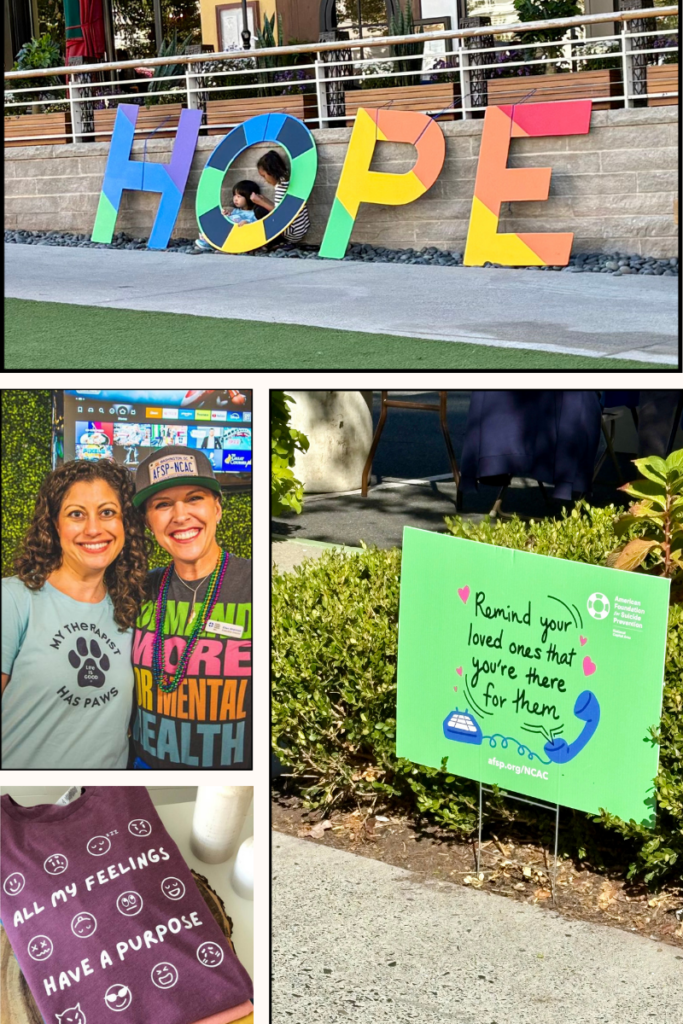
These walks matter deeply to me because everyone who walks, arrives with a different story. Some people walk for someone they lost, or for someone they love. Many walk because they themselves have struggled. While some walk because they survived. Some walk because someone else did not. And some simply walk because they believe we can create a world in which fewer families receive the phone call that changes everything.
There is grief at these events, certainly. But there is also tremendous love. There is community. There is also connection and remembrance. It is a powerful experience to look around and realize that none of us are alone in being touched by mental illness, suicide, grief, or loss. And there is hope.
Suicide Prevention Belongs to All of Us
You do not need to be a therapist to participate in suicide prevention. You do not need specialized training to notice another human being and care about how they are doing.
We can learn how to recognize when someone may be struggling. Check on the friend who has become unusually quiet.
We can ask someone how they are doing and stay long enough to hear the real answer. And we can take someone’s distress seriously rather than immediately trying to talk them out of their feelings. Most importantly, we can help someone connect with professional support when what they are carrying becomes too heavy to carry alone.
We can also challenge the language and attitudes that continue to stigmatize mental illness and asking for help. We can advocate for healthier schools, workplaces, healthcare systems, and communities. Teach children and teenagers that their emotional pain deserves attention. We can support healthcare professionals before they reach burnout. We can stand up against bullying, and create spaces where people feel that they belong.
Most importantly, we can create relationships and communities where people know that they matter before they reach the point of crisis.
Stay for the Next Chapter
When I think about Kelly, I sometimes wonder who she would be today. When I think about Tyler, I think about everything he should have had the opportunity to experience beyond eighteen. And when I think about Dr. Lorna Breen and Dr. William West, I think about the people who dedicate their lives to caring for others and how much more we need to do to care for them.
And when I think about the younger version of myself who was quietly struggling after college, I wish I could sit beside her for a moment. I would not tell her that everything was going to be easy, because it wasn’t. There would of course be heartbreak, grief and losses she could not anticipate. There would be periods of uncertainty and moments when life looked nothing like she imagined it would.
But there would also be so much she could not yet see. Yoga and meditation. Healing, love, writing and meaningful work. There would be people she had not met yet and places she had not traveled yet. Students she had not taught yet. There would be clients whose stories she had not yet been trusted to hold. And an entire life she could not possibly have imagined from where she was standing at 23 years old.
Perhaps that is what I most want someone who is struggling to know during National Suicide Prevention Month: You cannot see the whole path from where you are standing right now.
There are chapters of your life you have not lived yet, people you have yet to meet. There are moments of laughter, connection, love, meaning, peace, and possibility that you cannot possibly know are coming.
If you are struggling, please tell someone. If someone you love is struggling, stay connected to them. Ask the question. Listen to the answer. Help them find support. And if you are walking through a season of darkness yourself, please know that you do not have to find your way toward the light alone. Sometimes we need someone to stand beside us until we can see the path again.
That is why this month matters to me. That is why this work matters to me. And that is why I will continue to be involved with supporting people and causes that make a difference in the world.

Suicide Prevention & Mental Health Resources
If you or someone you know is experiencing suicidal thoughts or a mental health crisis: Call or text 988 to connect with the 988 Suicide & Crisis Lifeline. Support is available 24 hours a day, 7 days a week. If there is an immediate life-threatening emergency, call 911 or go to the nearest emergency department.
- 988 Suicide & Crisis Lifeline: Call or text 988, or visit the 988 Suicide & Crisis Lifeline website for crisis support and additional resources.
- American Foundation for Suicide Prevention (AFSP): AFSP provides suicide prevention education, resources for people affected by suicide, advocacy, research, and opportunities to become involved in local communities.
- AFSP National Capital Area Chapter: The National Capital Area Chapter serves Northern Virginia and Washington, D.C., with local education, programming, volunteer opportunities, advocacy, and Out of the Darkness Community Walks.
- You can also search for an Out of the Darkness Walk in your own community and walk in remembrance, in support of someone you love, or simply because you believe in a future with fewer lives lost to suicide.
- Dr. Lorna Breen Foundation: Learn more about the work being done to support the mental health and professional wellbeing of healthcare workers, reduce barriers to seeking mental healthcare, and continue Dr. Lorna Breen’s legacy.
- Tyler Clementi Foundation: Learn more about the Foundation created in Tyler’s memory and its work to end online and offline bullying and promote dignity, inclusion, and acceptance.
Please reach out, and stay connected. Please remember that asking for help is not weakness. Sometimes it is the first step toward a chapter you cannot see yet.
September 8, 2026
Leave a Reply


Be the first to comment